





 Email this article
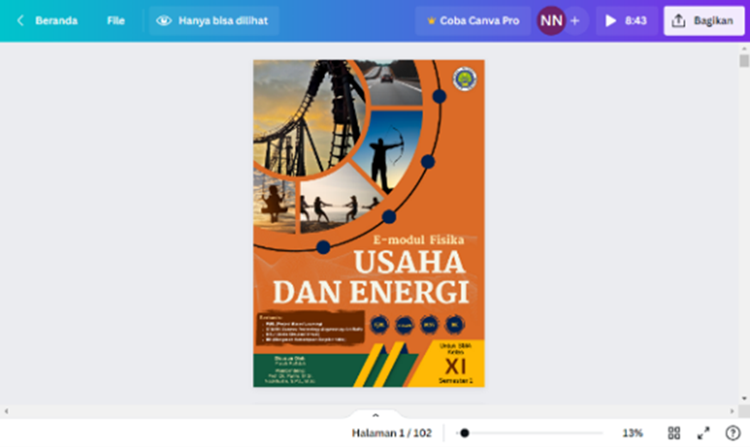
Development of E-modules Based on PjBL-STEAM and Virtual Simulation Media on Work and Energy Topic as an Effort to Improve Students’ Critical Thinking Skills
Abstract
Keywords
Full Text:
PDFReferences
Anisa, M. K., Permana, N. D., & Nova, T. L. (2020). Penggunaan simulasi virtual pada pembelajaran fisika untuk meningkatkan higher order thinking skill (HOTS) siswa: Meta analisis. Jurnal Kumparan Fisika, 3(2), 163–170. https://doi.org/10.33369/jkf.3.2.163-170
Astalini, A., Kurniawan, D. A., Perdana, R., & Kurniasari, D. (2018). Identification of student attitudes toward physics learning at Batanghari District high school. The Educational Review, USA, 2(9), 475–484. https://doi.org/10.26855/er.2018.09.003
Astro, R. B., Doa, H., & Hendro, H. (2020). Fisika kontekstual pembangkit listrik tenaga mikrohidro. Orbita, 6(1), 142–149. https://doi.org/10.31764/orbita.v6i1.1858
Astutik, S., Mahardika, I. K., Supeno, S., Indrawati, I., & Sugianto, F. (2020, May). Development of reqol (real quest outdoor learning) learning model to improve critical thinking skills (criticall thinking skill) in physics education. In IOP Conference Series: Earth and Environmental Science (Vol. 485, No. 1, p. 012111). IOP Publishing. https://doi.org/10.1088/1755-1315/485/1/012111
Badriyah, F. L., Mubarok, H., & Prahani, B. K. (2021). Profile of students' critical thinking skills and the implementation of PBLRQA based on blended learning in senior high school. Prisma Sains: Jurnal Pengkajian Ilmu dan Pembelajaran Matematika dan IPA IKIP Mataram, 9(1), 38–51. https://doi.org/10.33394/j-ps.v9i1.3911
Budialfiah, S., Haryoto, D., & Sulur, S. (2018). Pengaruh model pembelajaran 7E learning cycle berbantuan Edmodo terhadap peningkatan prestasi belajar peserta didik pada materi usaha dan energi. Jurnal Riset Pendidikan Fisika, 3(2), 7–14. https://doi.org/10.17977/um058v3i2p7-14
Clarita, T., & Sani, R. A. (2019). Efek model pembelajaran scientific inquiry dalam meningkatkan kemampuan berpikir kritis siswa di SMA N 1 Percut Sei Tuan. Jurnal Ikatan Alumni Fisika Universitas Negeri Medan, 5(3), 47–52. https://doi.org/10.24114/jiaf.v5i3.14695
Dywan, A. A., & Airlanda, G. S. (2020). Efektivitas model pembelajaran project based learning berbasis STEM dan tidak berbasis STEM terhadap kemampuan berpikir kritis siswa. Jurnal Basicedu, 4(2), 344–354. https://doi.org/10.31004/basicedu.v4i2.353
Endriska, Y., Lesmono, A. D., & Bachtiar, R. W. (2017). Pengembangan modul berbasis scientific approach pada pokok bahasan usaha dan energi untuk siswa MA. In Peran pendidikan, sains, dan teknologi dalam mengembangkan budaya ilmiah dan inovasi terbarukan untuk mendukung sustainable development goals (SDGs). Proceedings of the Seminar Nasional Pendidikan 2017 (Vol. 2, No. 1, pp. 1–6). Universitas Jember, Jember, Indonesia. Retrieved from https://jurnal.unej.ac.id/index.php/fkip-epro/article/view/6251
Ennis, R. H. (1993). Critical thinking assessment. Theory into Practice, 32(3), 179–186. https://doi.org/10.1080/00405849309543594
Erwiza, E., Kartiko, S., & Gimin, G. (2019). Factors affecting the concentration of learning and critical thinking on student learning achievement in economic subject. Journal of Educational Sciences, 3(2), 205–215. https://doi.org/10.31258/jes.3.2.p.205-215
Festiyed, F., Djamas, D., & Ramli, R. (2019, April). Learning model based on discovery learning equipped with interactive multimedia teaching materials assisted by games to improve critical thinking skills of high school students. In Journal of Physics: Conference Series (Vol. 1185, No. 1, p. 012054). IOP Publishing. https://doi.org/10.1088/1742-6596/1185/1/012054
Gidena, A., & Gebeyehu, D. (2017). The effectiveness of advance organiser model on students’ academic achievement in learning work and energy. International Journal of Science Education, 39(16), 2226–2242. https://doi.org/10.1080/09500693.2017.1369600
Guido, R. M. D. (2018). Attitude and motivation towards learning physics. International Journal of Engineering Research & Technology (IJERT), 2(11), 2087–2094. https://doi.org/10.17577/IJERTV2IS110659
Handayani, U., Masykuri, M., & Aminah, N. S. (2017). Pengembangan modul fisika berbasis problem based learning (PBL) untuk meningkatkan keterampilan berpikir kritis pada materi usaha dan energi di SMA/MA. Inkuiri: Jurnal Pendidikan IPA, 6(2), 107–116. https://doi.org/10.20961/inkuiri.v6i2.17316
Haqiqi, L. N. U., Akhdinirwanto, R. W., & Maftukhin, A. (2020). Pengembangan media pembelajaran modul fisika berbasis software sigil berekstensi epub untuk meningkatkan keterampilan berpikir kritis. Spektra: Jurnal Kajian Pendidikan Sains, 6(2), 125–133. https://doi.org/10.32699/spektra.v6i2.146
Hartini, A. (2017). Pengembangan perangkat pembelajaran model project based learning untuk meningkatkan kemampuan berpikir kritis siswa sekolah dasar. ELSE (Elementary School Education Journal): Jurnal Pendidikan dan Pembelajaran Sekolah Dasar, 1(2a), 6–16. https://doi.org/10.30651/else.v1i2a.1038
Heryani, T. P., Suwarma, I. R., & Chandra, D. T. (2023). Development of STEM-based physics module with self-regulated learning to train students critical thinking skills. Jurnal Penelitian Pendidikan IPA, 9(6), 4245–4252. https://doi.org/10.29303/jppipa.v9i6.3578
Jatmika, S., Jumadi, J., Pujianto, P., & Rahmatullah, R. (2021). Analisis penyebab kesalahan pemahaman siswa pada materi usaha dan energi. Indonesian Journal of Applied Science and Technology, 2(3), 97–105. https://journal.publication-center.com/index.php/ijast/article/view/1228
Kartika, A. C., Sutarno, S., & Purwanto, A. (2022). Pengembangan e-modul berorientasi model curious note program untuk melatihkan keterampilan berpikir kritis siswa SMA pada materi gelombang. Diksains: Jurnal Ilmiah Pendidikan Sains, 2(2), 62–73. https://doi.org/10.33369/diksains.2.2.62-73
Kwietniewski, K. (2017). Literature review of project based learning (Career & Technical Education Theses, The State University of New York, Buffalo, US). Retrieved from https://digitalcommons.buffalostate.edu/careereducation_theses/1/
Laili, I., Ganefri, G., & Usmeldi, U. (2019). Efektivitas pengembangan e-modul project based learning pada mata pelajaran instalasi motor listrik. Jurnal Ilmiah Pendidikan dan Pembelajaran, 3(3), 306–315. https://doi.org/10.23887/jipp.v3i3.21840
Lestari, U. P., Malik, A., & Mulhayatiah, D. (2016). Penerapan model brain based learning (BBL) untuk meningkatkan keterampilan berpikir kritis siswa pada materi usaha daunn energi. Journal of Teaching and Learning Physics, 1(2), 10–18. https://doi.org/10.15575/jotalp.v1i2.6590
Linda, R., Nufus, H., & Susilawati, S. (2020, June). The implementation of chemistry interactive e-module based on Kvisoft Flipbook Maker to improve student’self-learning. In AIP Conference Proceedings (Vol. 2243, No. 1). AIP Publishing. https://doi.org/10.1063/5.0002309
Mahdalena, M., & Daulay, M. I. (2020). Pengembangan pembelajaran fisika berbasis saintifik untuk meningkatkan kemampuan berpikir kritis dan komunikasi verbal siswa SMA. Journal on Teacher Education, 2(1), 39–48. https://doi.org/10.31004/jote.v2i1.903
Nada, A. Q., Taqwa, M. R., Supriana, E., & Suwasono, P. (2022). Development of an android-based physics interactive e-module equipped with problems with scaffolding in applying the concept of light waves. International Journal of Education and Teaching Zone, 1(2), 159–178. https://doi.org/10.57092/ijetz.v1i2.43
Nieveen, N. (1999). Prototyping to reach product quality. In J. van den Akker, R. M. Branch, K. Gustafson, N. Nieveen, & T. Plomp (Eds.), Design approaches and tools in education and training (pp. 125–135). Dordrecht, Netherlands: Springer. https://doi.org/10.1007/978-94-011-4255-7_10
Novelensia, E. T. P., Bektiarso, S., & Maryani, M. (2021). Penerapan pembelajaran kooperatif tipe numbered heads together (NHT) disertai metode eksperimen dalam pembelajaran fisika di SMA. Jurnal Pembelajaran Fisika, 3(3), 242–247. https://doi.org/10.19184/jpf.v3i3.23279
Nurazizah, S., Sinaga, P., & Jauhari, A. (2017). Profil kemampuan kognitif dan keterampilan berpikir kritis siswa SMA pada materi usaha dan energi. Jurnal Penelitian & Pengembangan Pendidikan Fisika, 3(2), 197–202. https://doi.org/10.21009/1.03211
Panggabean, D. D., & Sembiring, S. S. (2022). Pembuatan e-modul fisika berbasis problem based learning materi usaha dan energi. Jurnal Pendidikan Fisika, 11(2), 116–121. https://doi.org/10.24114/jpf.v11i2.38467
Parno, P., Anggraini, R. T., Hidayat, A., Fauziyah, S., Pramono, N. A., Supriana, E., & Ali, M. (2021, March). The building of students’ problem solving skills through STEM aproach with virtual simulation media. In Journal of Physics: Conference Series (Vol. 1842, No. 1, p. 012073). IOP Publishing. https://doi.org/10.1088/1742-6596/1842/1/012073
Parno, P., Fauziyah, S., Pramono, N. A., Anggraini, R. T., Hidayat, A., Supriana, E., & Ali, M. (2021, June). The increase of students’ critical thinking abilities on optical instrument topic through PBL-STEM with virtual simulation media. In Journal of Physics: Conference Series (Vol. 1918, No. 5, p. 052067). IOP Publishing. https://doi.org/10.1088/1742-6596/1918/5/052067
Parno, P., Nur’aini, D. A., Kusairi, S., & Ali, M. (2022). Impact of the STEM approach with formative assessment in PjBL on students’ critical thinking skills. In Journal of Physics: Conference Series (Vol. 2165, No. 1, p. 012044). IOP Publishing. https://doi.org/10.1088/1742-6596/2165/1/012044
Pendrill, A. M., & Eager, D. (2020). Velocity, acceleration, jerk, snap and vibration: Forces in our bodies during a roller coaster ride. Physics Education, 55(6), 065012. https://doi.org/10.1088/1361-6552/aba732
Pramesti, Y. S., Mahmudi, H., & Setyowidodo, I. (2020, April). Analyzing students’ understanding of work-energy concept. In Journal of Physics: Conference Series (Vol. 1521, No. 2, p. 022016). IOP Publishing. https://doi.org/10.1088/1742-6596/1521/2/022016
Priantari, I., Prafitasari, A. N., Kusumawardhani, D. R., & Susanti, S. (2020). Improving students critical thinking through STEAM-PjBL learning. Bioeducation Journal, 4(2), 94–102. https://doi.org/10.24036/bioedu.v4i2.283
Putra, R. P., Agustina, R. D., Pitriana, P., Andhika, S., Dermawan, M. D. S., & Nurfadillah, E. (2021). Developing HOT-LAB-based physics practicum e-module to improve practicing critical thinking skills. Journal of Science Education Research, 5(2), 43–49. https://doi.org/10.21831/jser.v5i2.41904
Putri, M. K., Parno, P., Munfaridah, N., & Ali, M. (2023). Exploring high school students’ concept mastery of work and energy topics: A quantitative descriptive study with insights for STEM learning. Jurnal Pendidikan Sains, 11(2), 56–64. https://doi.org/10.17977/jps.v11i22023p056
Rachniyom, S., Toedtanya, K., & Wuttiprom, S. (2017, September). Development of the concept of energy conservation using simple experiments for grade 10 students. In Journal of Physics: Conference Series (Vol. 901, No. 1, p. 012124). IOP Publishing. https://doi.org/10.1088/1742-6596/901/1/012124
Rahmawati, Y., Utomo, E., & Mardiah, A. (2021, November). The integration of STEAM-project-based learning to train students critical thinking skills in science learning through electrical bell project. In Journal of Physics: Conference Series (Vol. 2098, No. 1, p. 012040). IOP Publishing. https://doi.org/10.1088/1742-6596/2098/1/012040
Ravitz, J. (2010). Beyond changing culture in small high schools: Reform models and changing instruction with project-based learning. Peabody Journal of Education, 85(3), 290–312. https://doi.org/10.1080/0161956X.2010.491432
Saprudin, S., Haerullah, A. H., & Hamid, F. (2021). Analisis penggunaan e-modul dalam pembelajaran fisika: Studi literatur. Jurnal Luminous: Riset Ilmiah Pendidikan Fisika, 2(2), 38–42. https://doi.org/10.31851/luminous.v2i2.6373
Seprapti, A. I., Nizami, N., Haqqo, A., Fitriyah, A. L., Kusairi, S., & Parno, P. (2020). Pemahaman konsep dan kesulitan belajar mahasiswa: Studi lintas semester pada materi usaha energi. Jurnal Ilmiah Pendidikan Lingkungan dan Pembangunan, 21(01), 18–29. https://doi.org/10.21009/PLPB.211.03
Sivasailam, T., Semmel, D. S., & Semmel, M. I. (1974). Instructional development for training teachers of exceptional children. Bloomington, IN: Center for Innovation in Teaching the Handicapped, Indiana University.
Stohlmann, M. (2021). Integrated STEM education through game-based learning. In A. I. Sacristán, J. C. Cortés-Zavala, & P. M. Ruiz-Arias (Eds.), Mathematics education across cultures. Proceedings of the 42nd Meeting of the North American Chapter of the International Group for the Psychology of Mathematics Education, Mexico. https://doi.org/10.51272/pmena.42.2020-381
Sujanem, R., Suwindra, I. N. P., & Suswandi, I. (2020, July). The effectiveness of problem-based interactive physics e-module on high school students’ critical thinking. In Journal of Physics: Conference Series (Vol. 1503, No. 1, p. 012025). IOP Publishing. https://doi.org/10.1088/1742-6596/1503/1/012025
Sulastri, S., & Cahyani, G. P. (2021). Pengaruh project based learning dengan pendekatan STEAM terhadap kemampuan berpikir kritis pada pembelajaran online di SMK Negeri 12 Malang. Jurnal Pendidikan Akuntansi (JPAK), 9(3), 372–379. https://doi.org/10.26740/jpak.v9n3.p372-379
Susanti, N., Yennita, Y., & Azhar, A. (2020). Development of contextual based electronic global warming modules using flipbook applications as physics learning media in high schools. Journal of Educational Sciences, 4(3), 541–559. https://doi.org/10.31258/jes.4.3.p.541-559
Widarwati, D., & Utaminingsih, S. (2021, March). STEAM (science technology egineering art mathematic) based module for building student soft skill. In Journal of Physics: Conference Series (Vol. 1823, No. 1, p. 012106). IOP Publishing. https://doi.org/10.1088/1742-6596/1823/1/012106
Yusufa, M. L., Parno, P., & Fitriyah, I. J. (2021, December). Development of AR-based interactive teaching materials equipped with the IBL-STEM model to improve the scientific literacy of JHS students on the topic of the human circulatory system. In International Joint Conference on Science and Engineering 2021 (IJCSE 2021) (pp. 281-287). Atlantis Press. https://doi.org/10.2991/aer.k.211215.051
Zubaidah, S. (2019, September). STEAM (science, technology, engineering, arts, and mathematics): Pembelajaran untuk memberdayakan keterampilan abad ke-21. In STEAM Terintegrasi Kearifan Lokal dalam Menghadapi Era Revolusi Industri 4.0. Proceedings of the Seminar Nasional Matematika dan Sains (pp. 1-18). Universitas Wiralodra, Indramayu, Indonesia.
DOI: http://dx.doi.org/10.17977/jps.v12i32024p093